Work = Rate × Time — (Simple formula)
One worker, many hands, or a single machine clearing the ground — the logic never changes. Set what you know below and let the calculator do the digging.
Time and Work Questions Calculator
Solve for
Enter how long each worker takes time to complete the job alone. Find total time working together.
About This Calculator
This is free website for solving work-rate problems — the kind that show up in classroom homework, competitive exams, and everyday job-planning, all built on one simple rule: work equals rate multiplied by time.
Time and work questions ask how long a task takes when one or more workers, machines, or pipes act together — or how many hands are needed to hit a deadline. The trick is converting "days to finish" into a daily rate, then adding rates together. This calculator automates that conversion and shows every step, so you can check your own working or simply get the answer fast.
It runs entirely in your browser — no sign-up, no data sent anywhere, and no limit on how many times you use it. Switch between days, hours, and minutes freely in any input; the tool normalizes units before calculating, so mixed-unit problems (one worker's time in days, another's in hours) are handled correctly without manual conversion.
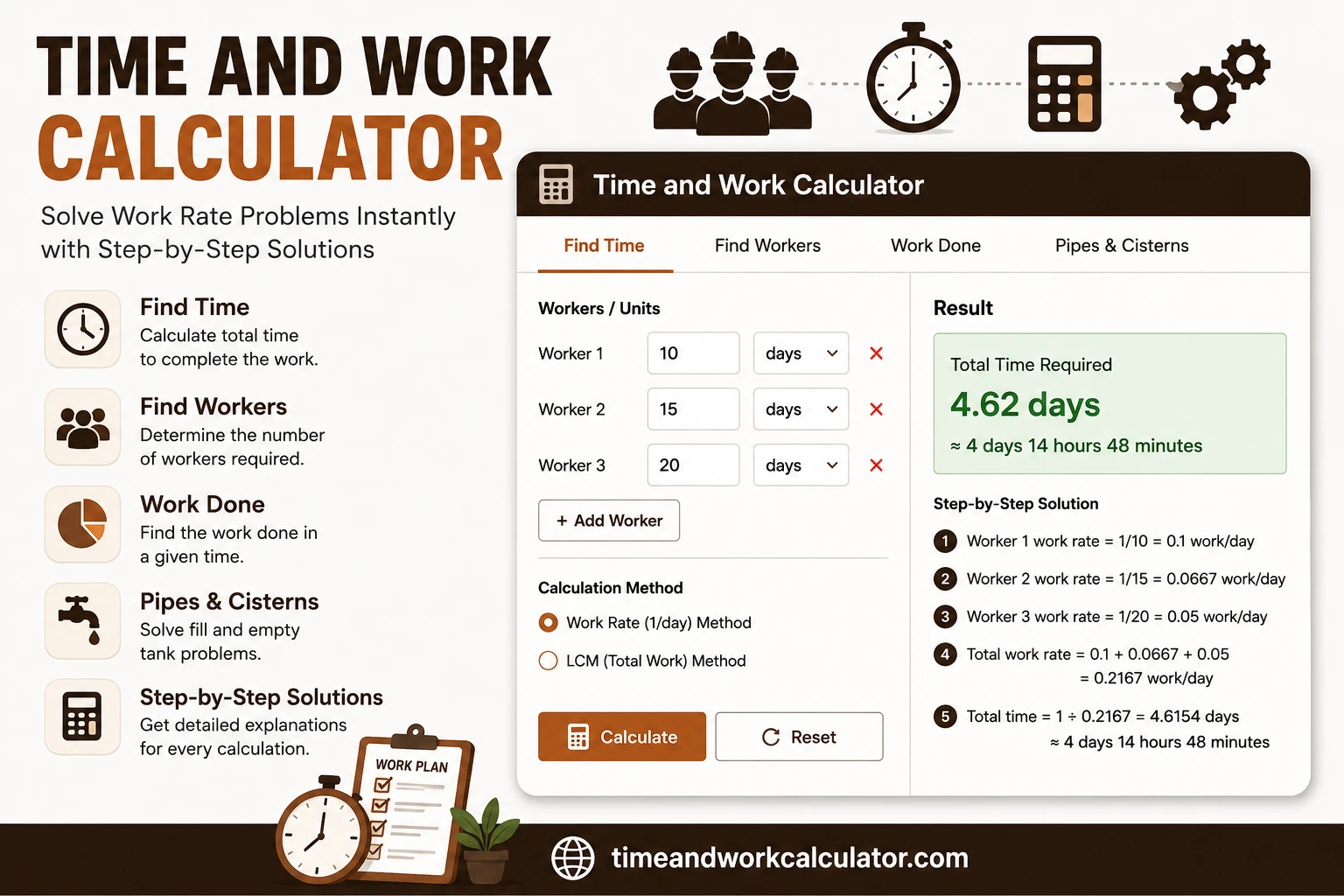
What It Solves
Find Time
Given how long each worker takes alone, find how long they take working together — for any number of workers, not just two.
Find Workers Needed
Given a deadline and each worker's solo speed, find the minimum number of workers required to finish on time.
Work Done in a Given Time
Given a fixed working period, find what fraction or percentage of the job gets completed — and what's left over.
Pipes & Cisterns
Mix filling and emptying pipes to find the net time to fill or drain a tank, with outlet pipes subtracted automatically.
Question Types Covered
- Two or more workers (or machines) completing a job together
- Workers joining or leaving partway through a task
- Efficiency comparisons — one worker twice as fast as another, and similar ratios
- Wages divided in proportion to work contributed
- Pipes and cisterns, including combined inlet and outlet pipes
- Mixed time units within a single problem (days, hours, minutes together)
Who It Helps
Time and work is a standard topic in quantitative aptitude and numerical reasoning sections worldwide, so the calculator is useful well beyond any one exam or country:
- Government and competitive exam aspirants — common in aptitude sections of recruitment and banking exams across South Asia
- School and college students — covers arithmetic and ratio-based work problems taught in general mathematics curricula
- MBA and graduate admissions test takers — work-rate questions appear in quantitative reasoning sections internationally
- Project planners and managers — quick estimates for staffing a task against a deadline
- Teachers and tutors — a step-by-step reference for explaining the rate method in class

Last updated:
How Time & Work Calculations Work
Every time and work problem is based on one principle: Work = Rate × Time. Here's the logic step by step.
Work Rate
If a worker finishes a job in N days, their rate is 1/N per day. This is the fraction of the total job they complete each day.
Combined Rate
When multiple workers collaborate, their rates simply add up. The total time is the reciprocal of the combined rate.
Workers Needed
To finish by a deadline T, divide each worker's solo time D by T. Round up to the nearest whole number.
Pipes & Cisterns
Filling pipes add to the net rate; emptying pipes subtract. The cistern fills when net rate is positive.
Real-Life Uses
Work-rate math isn't only for exam halls — the same Work = Rate × Time logic drives staffing and scheduling decisions across many industries:
- Construction projects — estimating how many laborers or contractors are needed to finish a phase before the next one starts
- Manufacturing planning — balancing output across multiple machines or shifts to hit a production target
- Workforce scheduling — covering a task reliably when staff availability or shift length changes day to day
- Agriculture — planning harvest labor across a field or timing irrigation pumps that run on different cycles
- Factory production — combining the throughput of several lines or stations to meet a delivery deadline
- Cleaning services — sizing a crew correctly for a job that has to be finished within a fixed turnaround window
- Event management — coordinating setup and teardown teams that only have a narrow slot to work in
- Machine productivity — comparing the combined output of several machines or appliances running at once
Solved Examples
Click any row to load it into the calculator above.
| Type | Problem | Answer | Try |
|---|---|---|---|
| Find Time | A takes 10 days, B takes 15 days. Together? | 6 days | |
| Find Workers | Each worker takes 12 days. Finish in 3 days? | 4 workers | |
| Work Done | A=10d, B=20d working together for 4 days? | 60% | |
| Pipes | Pipe A fills in 6h, Pipe B empties in 12h? | 12 hours | |
| Find Time | A=6d, B=8d, C=12d. Together? | ≈ 2.67 days |
Time & Work Formula Reference
| What to Find | Formula | Notes |
|---|---|---|
| Combined time (2 workers) | T = (A × B) ÷ (A + B) | A, B = individual times |
| Combined time (n workers) | T = 1 ÷ (1/T₁ + 1/T₂ + …) | Add all rates, take reciprocal |
| Workers needed | W = D ÷ T_target | D = days each alone; round up |
| Work done in time t | W = t × (1/T₁ + 1/T₂ + …) | Fraction of total job |
| Remaining work | Rem = 1 − W | 1 = full job = 100% |
| Pipe fill time | T = 1 ÷ (Σfill − Σempty) | Emptying rates subtracted |